

Real Estate Trust Accounting: What Every Broker-Owner Needs to Know
Trust accounting is the part of running a brokerage where the stakes are highest and the margin for error is zero.
Get it wrong and you're looking at a compliance investigation, license risk, and the kind of disruption that takes months to resolve. Get it right and it's invisible. Nobody calls you about a trust account that's reconciling cleanly every month.
Most broker-owners understand trust accounting in broad strokes. What I've found after 9 years working inside brokerage operations is that the broad strokes aren't enough. The errors almost always happen in the details. The timing rules. The three-way reconciliation. The commingling that happens by accident because someone used the wrong account. This guide covers the details.
It's written for broker-owners and their admins, not for accountants. If you're managing a brokerage in the US or Canada, this is what you need to know.
What is real estate trust accounting?
Real estate trust accounting is the management of funds held by a brokerage on behalf of others. Primarily buyer deposits and earnest money, and sometimes rental income or security deposits depending on the services your brokerage offers.
The word "trust" is doing important work here. These funds are not yours. They belong to the parties in the transaction. The buyer who put down earnest money. The seller waiting on proceeds. The client whose deposit is sitting in your account while conditions are cleared. Your brokerage holds them temporarily, in a position of trust, and is legally obligated to account for every dollar.
Real estate commissions and transaction fees flow through a separate set of accounts. Trust accounting refers to client funds. Money that comes into your brokerage's custody but belongs to someone else.
Every US state and Canadian province with a real estate regulatory body has rules about how these funds must be handled. They're not guidelines. They're requirements with license consequences for violations.
Why trust accounting violations happen, and why intent doesn't protect you
Here's the part that surprises most broker-owners: you can lose your license over a trust accounting violation even if no one was harmed and you had no intention of doing anything wrong.
California DRE enforces trust account rules strictly, requiring brokers to document compliance regardless of intent or consumer harm. Most state real estate commissions operate the same way.
The logic is sound. The purpose of trust accounting rules is to ensure client funds are protected before something goes wrong, not to punish brokers after a theft. Regulators don't wait to see whether harm occurred. They check whether your procedures were compliant, whether your records were accurate, and whether your accounts were reconciled correctly. If the answer to any of those is no, that's a violation.
The most common trust accounting violations in broker audits are not fraud. They are:
Commingling. Mixing client funds with operating funds in the same account. This often happens by accident. A deposit goes into the wrong account, or someone transfers money between accounts without realizing the implication.
Timing violations. Most states require deposits to be made within one or two business days of receipt. Missing that window, even by a day, is a violation. California requires funds be deposited by the end of the next business day following receipt. Most other states have similar rules.
Deficit spending. Using trust funds to cover operating expenses, even temporarily, even with full intention to repay. The moment operating money and client money mix, you have a commingling violation.
Reconciliation failures. Not completing the required monthly three-way reconciliation, or completing it but having the numbers not agree.
Record-keeping failures. Not maintaining adequate records of each transaction's funds, or not keeping them for the required retention period.
None of these require bad intent. All of them can result in an audit, a fine, license suspension, or worse. Deliberate wire and deposit fraud is a related but separate risk. See our guide to wire fraud and trust account scams for how brokerages can protect client funds from bad actors, not just internal errors.
How a brokerage trust account actually works
The mechanics are straightforward once you understand the structure.
The dedicated trust account
Your brokerage must maintain a separate bank account, distinct from your operating account, for client funds only. This account must be titled in a way that clearly identifies it as a trust or escrow account held by your brokerage. It needs to be at an approved financial institution, and set up so the bank notifies your real estate commission if any item is presented for payment against insufficient funds.
You cannot use this account for operating expenses. You cannot use it to pay your own commissions. Operating revenue does not touch it. The broker's own money does not touch it.
Most brokerages can hold a small amount of their own funds in the trust account to cover bank service charges. Usually $200 or less. Beyond that, only client funds belong there.
The trust ledger
For every dollar in the trust account, your records must show exactly whose money it is and which transaction it belongs to. This is the trust ledger. A running record of every deposit and disbursement, tracked by client and by deal.
If your trust account has a balance of $312,500 at any point, you must be able to produce a list of individual client balances that add up to exactly $312,500. Not approximately. Exactly.
This is where brokerages with high transaction volume run into trouble. When deals are moving fast, individual ledger entries get missed, amounts get entered incorrectly, or timing errors accumulate. By the time something seems off, the variance can be difficult to trace.
The three-way reconciliation
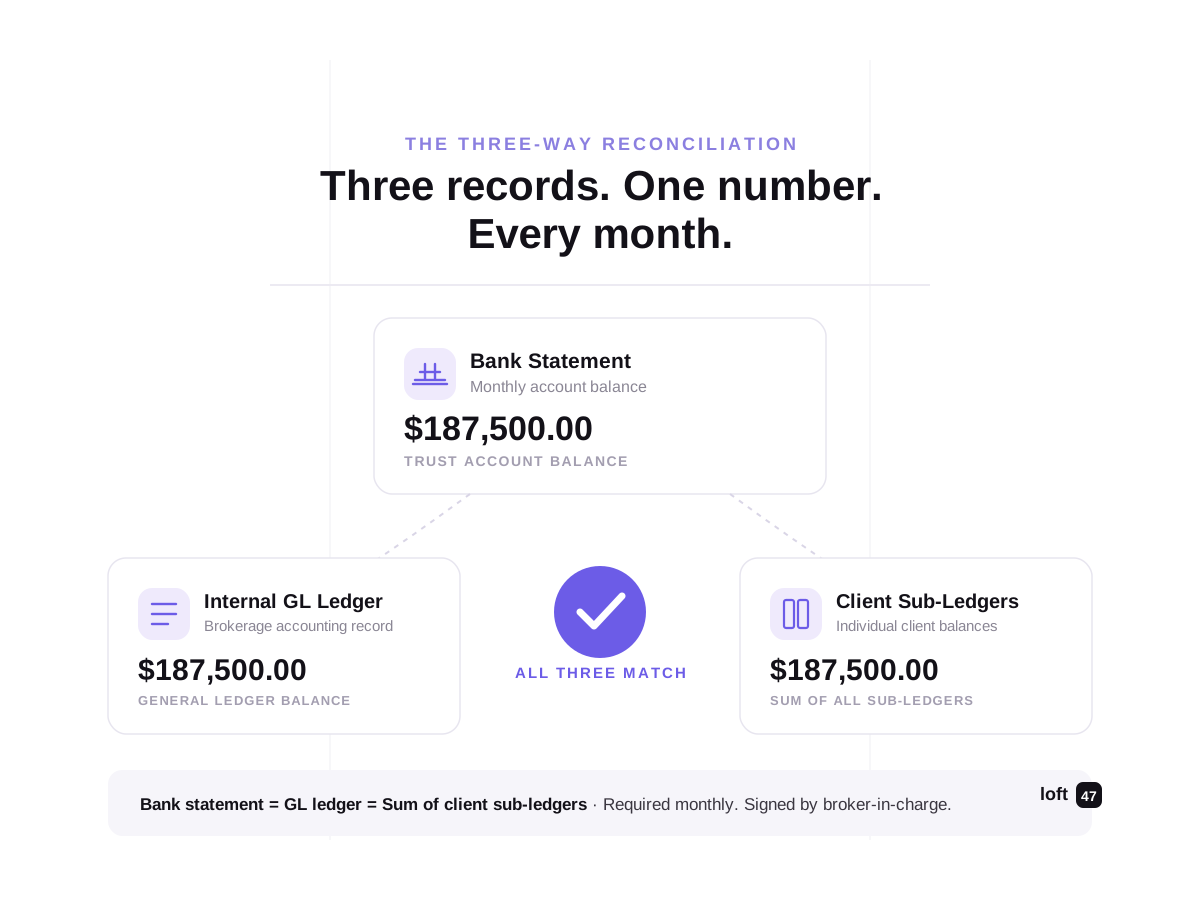
Once a month, you are required to reconcile three independent records:
- Your bank statement for the trust account
- Your brokerage's internal trust account ledger
- The sum of all individual client sub-ledgers
If the bank says $187,500, the GL says $187,500, and the sub-ledgers add up to $187,500, the brokerage is reconciled. If any one of the three is off by even a dollar, you cannot sign the worksheet until the variance is found and explained.
This three-way reconciliation is the most commonly cited compliance item in real estate commission audits. It's also the most commonly failed one. Not because broker-owners don't understand it, but because doing it manually across high transaction volumes is genuinely hard to keep clean. For a full walkthrough of the process, see our step-by-step guide to three-way trust account reconciliation.
The reconciliation must be signed by the broker-owner. In most jurisdictions, the broker-in-charge carries personal liability for trust account compliance. Delegating the work to an admin doesn't transfer the liability.
Run your last 12 months of commission data through our free Commission Health Check. It runs entirely in your browser, and nothing is uploaded or stored. Five minutes, and you'll see where the risk is hiding.
Trust accounting in Canada vs the United States
The mechanics are similar in both markets, but there are real differences in terminology, regulation, and timing.
In Canada, the equivalent of the US trust account is often called a "pooled trust account" or simply a "trust account," and the rules are set at the provincial level rather than the state level. In Alberta, for example, the Real Estate Act and RECA set the requirements. In BC, it's BCFSA. Each province has its own rules on holding periods, reconciliation timing, and record retention.
One important Canadian-specific detail: GST on commissions. In the US, commissions are generally not subject to sales tax. In Canada, GST at 5% applies to real estate commissions. This affects how commission proceeds are handled through the trust account. The brokerage must track and remit the tax portion correctly.
From our commission report data covering 9,791 Canadian deals: the average conditional period adds 11 days to the time funds sit in trust before a deal firms up. That's 11 additional days during which the funds must be tracked, the records must be clean, and the three-way reconciliation must be current. In a market with a high deal collapse rate, a significant number of deposits need to be returned cleanly, with documentation showing the refund matches the original deposit to the penny.
The situations that create trust accounting problems
After 9 years processing transactions for brokerages across 39 US states and 6 Canadian provinces, these are the scenarios where trust accounting problems most commonly occur.
Deal collapses
When a deal collapses after an earnest money deposit has been made, the deposit needs to be returned to the appropriate party. Usually the buyer, unless there's a dispute. The timing, the documentation, and the record-keeping around that return need to match the original deposit exactly.
In high-volume brokerages, collapsed deals can pile up. Each one requires a clean return, a signed release, and a ledger entry. When that process is managed manually, errors accumulate.
Back-to-back closings
Some transactions involve a buyer and seller who are also selling or buying another property at the same time. Funds from one transaction may be needed for another. The temptation to temporarily move trust funds to facilitate timing is significant. It's also a violation. Each transaction's funds must be tracked independently.
Outside brokerage payouts
When a commission is split between your brokerage and an outside brokerage, the funds flow through the trust account before being distributed. Tracking which portion of a trust deposit flows to which party, and ensuring both brokerages receive accurate amounts at the right time, requires precise ledger management.
Multi-party transactions
Team deals, double-ended transactions, referral fee arrangements. Any transaction with more than two agents involved requires careful tracking of which portion of the commission flows where. A trust account handling five-way splits on a luxury team deal is significantly more complex than a standard two-way commission.
New admins
The single biggest trust accounting risk in most brokerages is staff turnover. Trust accounting procedures live in people's heads, not in documented systems. When the person who knew how to do the month-end reconciliation leaves, what they knew leaves with them. The new admin learns on the job, and the errors begin.
How to stay compliant: a practical checklist for broker-owners
This isn't a substitute for understanding your state or provincial rules. But these practices hold across most jurisdictions.
Daily
Every client deposit received goes into the trust account by the next business day. No exceptions, no temporary holding in operating accounts. Every trust account transaction is recorded in the ledger the same day it occurs.
Per deal
Each transaction has its own sub-ledger entry showing the deposit amount, the date received, the parties, and any disbursements. No funds leave the trust account without broker approval and written documentation of the authorization. Disbursements to agents don't happen until the deal is closed and all compliance requirements are met.
Monthly
The three-way reconciliation is completed within the first week of the following month. Bank statement, internal ledger, and individual sub-ledger balances all reconcile to the same number. The signed reconciliation worksheet is retained with supporting documents. Any variance, no matter how small, is investigated and explained before the reconciliation is signed.
Annually
Review your state or provincial trust accounting requirements. Rules change, and what was compliant last year may not be current. Look at your own procedures: does your process depend on one person who knows how it works? If yes, that's a risk worth documenting and addressing. Verify your record retention, because most jurisdictions require trust account records to be kept for three to five years.
The most important question to ask about your current trust accounting setup
Here it is.
If your primary admin was suddenly unavailable for a month, would your trust account stay compliant?
If the honest answer is "I'm not sure" or "probably not," that's the vulnerability to address. It's not a criticism. It's the reality in most brokerages. The procedures that should live in a documented system live in one person's habits instead.
The other question worth asking: Can you produce a reconciled trust account report for any given day in the past 12 months within one hour?
That's the bar regulators set. An audit doesn't come with advance notice. The records need to be current, accurate, and accessible.
If you can't answer both questions confidently, you're not at immediate risk. You're just closer to risk than you should be.
What changes when trust accounting is handled in software vs. manually
Most brokerages still manage trust accounting through a combination of spreadsheets and accounting software that wasn't built for real estate. QuickBooks can handle some of it, but not the transaction-level commission math that makes up the majority of the broker's financial management work.
The problem with adapting general accounting software for real estate trust accounting is that the ledger structure doesn't naturally map to how trust funds move. Each transaction needs its own sub-ledger. The three-way reconciliation requires pulling data from three separate sources and comparing them. The timing rules require tracking receipt dates precisely. None of this is impossible in QuickBooks, but all of it requires manual process discipline that erodes over time, especially when transaction volume is high.
Software built for real estate trust accounting, Loft47 included, maintains the sub-ledger structure automatically. Every transaction has its own record. The three-way reconciliation runs as a report, not a manual exercise. Disbursements require broker approval before they can be processed. The audit trail is generated automatically and is always current.
The change isn't just efficiency. It's that the compliance structure is built into the workflow instead of depending on the admin remembering to do the right thing in the right order every time.
FAQ
What's the difference between a trust account and an escrow account in real estate?
The terms are often used interchangeably, but they have distinct meanings in some jurisdictions. An escrow account is held by a neutral third party, typically a title company, escrow company, or attorney, to hold funds until conditions of a transaction are met. A trust account is held by the brokerage itself on behalf of its clients.
In states where brokerages hold deposits directly, the brokerage's trust account is the mechanism. In states where title companies typically hold escrow, brokerages may have less involvement with the funds. Knowing which applies in your jurisdiction matters.
How often does a real estate commission audit a brokerage's trust account?
It varies by state and province. Some commissions conduct random spot inspections. Most also audit when a complaint is filed or when an NSF notice comes from the bank.
The practical answer: you should be audit-ready at all times, because you don't know when an audit will happen.
Can I be held personally liable for trust accounting violations as a broker-owner?
Yes. The broker is personally responsible for trust account compliance, even when delegating the work to staff. Delegating the day-to-day work to an admin doesn't transfer the legal liability. The broker-in-charge is the accountable party.
What happens if my brokerage has a trust account discrepancy?
A discrepancy triggers an investigation. Depending on the size, the cause, and your state's or province's rules, the outcome can range from a required corrective action plan to a fine to license suspension. If the discrepancy appears to involve intentional misappropriation, criminal charges are possible.
The best outcome from a discrepancy is that it's found and corrected during your own internal reconciliation process, before an audit finds it.
How long do I need to keep trust account records?
Most jurisdictions require three to five years. The safe answer is to keep them for at least five years, stored in a way that makes them searchable and producible on short notice. Regulators can request records going back several years during an audit.
What's the difference between trust accounting in the US and Canada?
The mechanics are similar. Dedicated accounts, sub-ledgers, monthly reconciliations. The differences are in the regulatory bodies (state vs provincial), the timing rules, and the treatment of GST on Canadian commissions. Canadian brokerages also deal with longer deal timelines and a higher deal collapse rate, which adds complexity to tracking funds held during conditional periods.
A final note on what trust accounting tells you about your brokerage
A clean trust account isn't just a compliance exercise. It's a signal about the overall financial health of your brokerage operations.
Brokerages where trust accounting is clean tend to have other things in order too. Commission calculations are accurate. Agent payouts are on time. Month-end close is predictable. It's not coincidental. The discipline required to maintain a clean trust account is the same discipline that makes the rest of the back office run well.
The brokerages that get into trust accounting trouble are almost always the same ones where the back office is held together by one person's memory, where the spreadsheets haven't been reconciled in two months, and where the broker-owner is the last to know when something is wrong.
The goal isn't compliance for its own sake. It's running a brokerage where you know what's happening financially at any given moment, and where the answer to "how's the trust account?" is always "clean."
Try the free Commission Health Check. Five minutes, nothing stored, no strings attached.


.svg)
.svg)