

Real Estate Franchise vs Independent Brokerage: Who Actually Owns Your Data?
Compass acquired Anywhere Real Estate. That's Coldwell Banker, Century 21, Sotheby's International Realty, Corcoran, and ERA — all under one corporate roof. Rocket acquired Redfin. Real Brokerage acquired RE/MAX for $880 million, creating Real REMAX Group. The industry is consolidating faster than it has in decades, and the deals aren't slowing down.
Most of the coverage focuses on what this means for agents. Brand recognition. Commission splits. Recruiting. Those are real concerns. But there's a question that broker-owners specifically need to be sitting with right now, and it's not getting nearly enough attention.
Who owns your financial data?
The consolidation wave is not just about brands
When Compass acquired Anywhere Real Estate, it wasn't buying the Coldwell Banker name. It was buying the transaction data, the agent relationships, the financial infrastructure, and the ability to roll its own technology platform across all of those brokerages at scale.
Compass is already doing exactly that. As of mid-2026, it's deploying its Home Platform to agents across its acquired brands — replacing the technology those brokerages previously used. Franchise operators who had their own tech stack, their own back office software, their own financial data sitting in their own systems are now watching that get migrated onto a Compass-controlled platform.
That's not necessarily sinister. It might even be a better product. But here's the thing that matters for any broker-owner evaluating their own situation: when your financial data lives on someone else's platform, the data doesn't fully belong to you anymore.
What "your data" actually means for a brokerage
Your brokerage generates financial data constantly. Commission splits on every deal. Trust account deposits and disbursements. Agent payout histories. Deal timelines. Gross commission income. Brokerage retained revenue. Deduction structures. Referral fee flows.
This isn't abstract information. It's the complete picture of how your business performs.
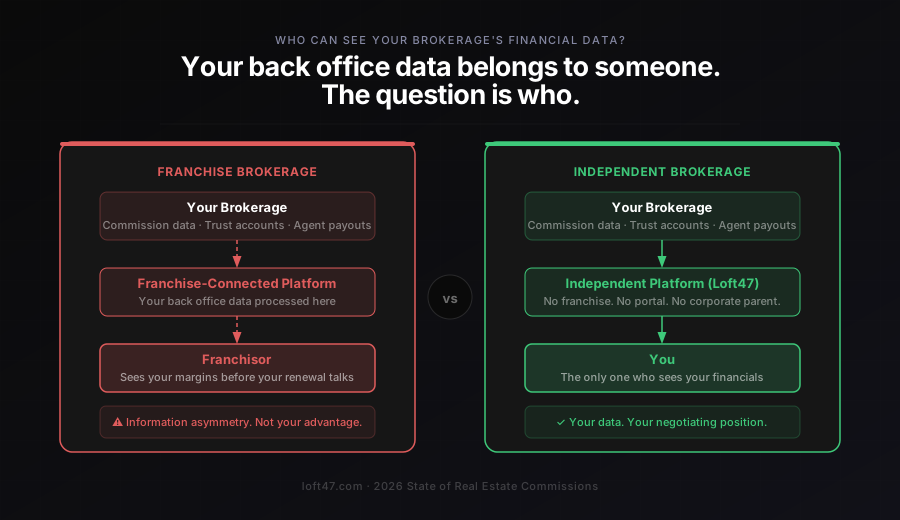
If you're a franchise brokerage and your back office software is connected to your franchisor's systems, your franchisor can potentially see your margins, your deal volume, your highest-producing agents, and your payout structures. Most franchise agreements don't explicitly say this. Most broker-owners haven't thought carefully about whether it's true for their specific setup.
But when you're negotiating your franchise renewal, when you're discussing your royalty rate, when you're deciding whether to add an office or stay put — you are sitting across the table from someone who may already know your numbers. That's not a level negotiating position.
The question most broker-owners don't ask
I've been working with real estate brokerages for 9 years. The question that almost never comes up in conversations about back office software is this: if I leave, what happens to my data?
Not "can I export it." Not "do I technically own it." What actually happens.
Does the vendor hold your historical transaction data hostage while you transition? Does your franchisor retain access to data generated during your franchise term? If your back office platform gets acquired by a competitor, does your financial history transfer to a company that has a vested interest in how your brokerage performs?
These are not paranoid questions. They're the natural consequence of a consolidating industry where the lines between franchisor, technology vendor, and financial services provider are blurring rapidly.
Rocket bought Redfin. A mortgage company now owns a brokerage and a technology platform. Real bought RE/MAX. A tech-forward brokerage now owns a global franchise network. Compass owns the brands, the agents, and increasingly the technology that processes their transactions.
Every one of these deals puts more financial data about more broker-owners into fewer corporate hands.
Franchise vs independent: the data ownership reality
This isn't an argument for or against franchise brokerages as a business model. There are strong franchise brokerages run by sophisticated operators who have negotiated their agreements carefully. There are independent brokerages that are poorly run and have no clearer picture of their own data than a franchise operator does.
The distinction that matters is simpler: do you know where your financial data lives, who can access it, and what your rights are if the relationship changes?
For most franchise broker-owners, the honest answer involves some uncertainty. Franchise agreements are long and complex. Technology provisions have often been added as amendments over time. The system your franchisor recommended for back office management may have been acquired since you signed up. The data you've generated over five or ten years may sit in a system whose ownership has changed.
For independent broker-owners, the picture should be clearer — but isn't always. Independent doesn't automatically mean your data is protected. It depends entirely on the vendors you've chosen and the agreements you've signed with them.
The question isn't franchise or independent. The question is: have you actually looked at who holds your financial data and what they can do with it?
What to look for in your back office software agreement
Most broker-owners sign a software agreement when they set up their back office and never look at it again. Here's what's actually in those agreements that matters.
Data ownership clause. This should explicitly state that your brokerage owns the data generated in the platform. Not a license to access your data. Ownership. If the clause says the vendor can use your data for any purpose, that's worth understanding.
Portability on exit. What happens to your data if you cancel? Some agreements give you a 30-day window to export your historical records. Some give you nothing. Some charge for an export. Know this before you need it.
Third-party sharing provisions. Many software agreements include clauses that allow the vendor to share anonymized or aggregated data. In practice, "anonymized" data from a small enough brokerage can still be identifiable. If your vendor is affiliated with or owned by a company that has a financial interest in your brokerage's performance, this matters.
Acquisition provisions. What happens to the agreement if the vendor is acquired? Does the new owner inherit all the terms, or is there a notification and opt-out period? Software acquisitions in real estate have accelerated dramatically. The company you signed with two years ago may be owned by a different entity now.
Franchise integration provisions. If you're a franchise brokerage, your franchise agreement and your software agreement may interact in ways you haven't mapped out. Some franchise systems require back office data to flow to franchisor reporting systems as a condition of the franchise. That reporting requirement doesn't disappear because you switch software.
What the consolidation means for the next five years
The deals announced in 2025 and 2026 are not the end of this wave. They're the beginning of a consolidation pattern that historically runs for years once it starts.
That creates a specific problem for broker-owners making technology decisions today. The software you choose now will hold years of your financial history. The vendor you sign with today may look very different in three years. The franchisor you're affiliated with may have new corporate parents, new technology mandates, and new data sharing arrangements that didn't exist when you signed your agreement.
Independent brokerages that choose their technology vendors carefully — on the basis of data ownership, portability, and vendor independence — are building a more defensible position. Not just from a competitive standpoint. From the standpoint of knowing that the financial story of their brokerage belongs to them.
That matters when you're selling the business. It matters when you're bringing on a partner. It matters when you're negotiating with a franchisor. It matters when a competitor wants to know how your office actually performs.
Your financial data is not an IT consideration. It's a strategic asset.
What independent broker-owners should be doing right now
This isn't about switching software or leaving your franchise. It's about doing a simple audit of where you actually stand.
Pull your current back office software agreement and find the data ownership clause. Read it. If you can't find it or it's unclear, ask your vendor directly: do I own my data, and what happens to it if I cancel?
If you're a franchise brokerage, find out whether your franchise agreement requires any financial data to flow to your franchisor's systems, and through which platform.
Find out what "portability" means in practice for your current vendor. Not what the contract says — what the actual export process looks like, what format your data comes out in, and how long it takes.
And then make a deliberate choice about whether that's acceptable, rather than defaulting to it by inertia.
How Loft47 approaches this
I'll be direct about our position because I think broker-owners deserve a vendor who is.
Loft47 is independently owned. We're not affiliated with any franchise, portal, or corporate group. We don't have a parent company with a financial interest in your brokerage's performance. We don't share your financial data with third parties beyond what's required to operate the platform.
Your data is yours. When you leave — which we don't expect, but which you're always free to do — you take it with you. There are no contracts, no lock-in periods, and no exit fees for accessing your own records.
We built the platform this way because it's the only way we'd want it to work if we were on the other side of that agreement. And because we think broker-owners who have chosen independence deserve software that reflects that choice.
If you're evaluating back office software right now, ask every vendor the same questions you should be asking us. If they hedge on data ownership or portability, that's information.
The broader point
The consolidation wave is real and it's not slowing down. Some broker-owners will find opportunities in it. Others will find their autonomy narrowing in ways they didn't anticipate.
The ones who navigate it best will be the ones who've thought carefully about which parts of their operation they control and which parts they've handed to someone else.
Your financial data is one of the clearest answers to that question. Either you own it, or you've handed it to someone who does.
That's worth knowing.


.svg)
.svg)